Sneak Peek: Sensor Analysis is Coming to ONE AI

So far, ONE AI has been all about vision: classification, object detection and segmentation models that run on any hardware, from FPGAs and microcontrollers to GPUs. Now we are taking the same workflow to a new kind of data: time-series signals from the machines themselves.
From Raw Sensor Data to a Model on Your Hardware
Sensor Analysis is a new part of the ONE AI extension for ONE WARE Studio, built for condition monitoring, predictive maintenance and quality inspection. It covers both continuous measurements, such as temperature or pressure, and cycled data, such as load cycles of an industrial press. The workflow follows three steps: bring in your signals and data, segment them into cycles or windows, and train a model for your target hardware.
Built for Real Machine Data
Real sensor setups are rarely tidy. Sensor Analysis is designed around that:
- Signals and channels: each sensor has its own sample rate and can have several channels, like the three axes of an accelerometer.
- Flexible segmentation: split data into cycles or windows, keep multiple segmentations per dataset, and work with cycles of different lengths.
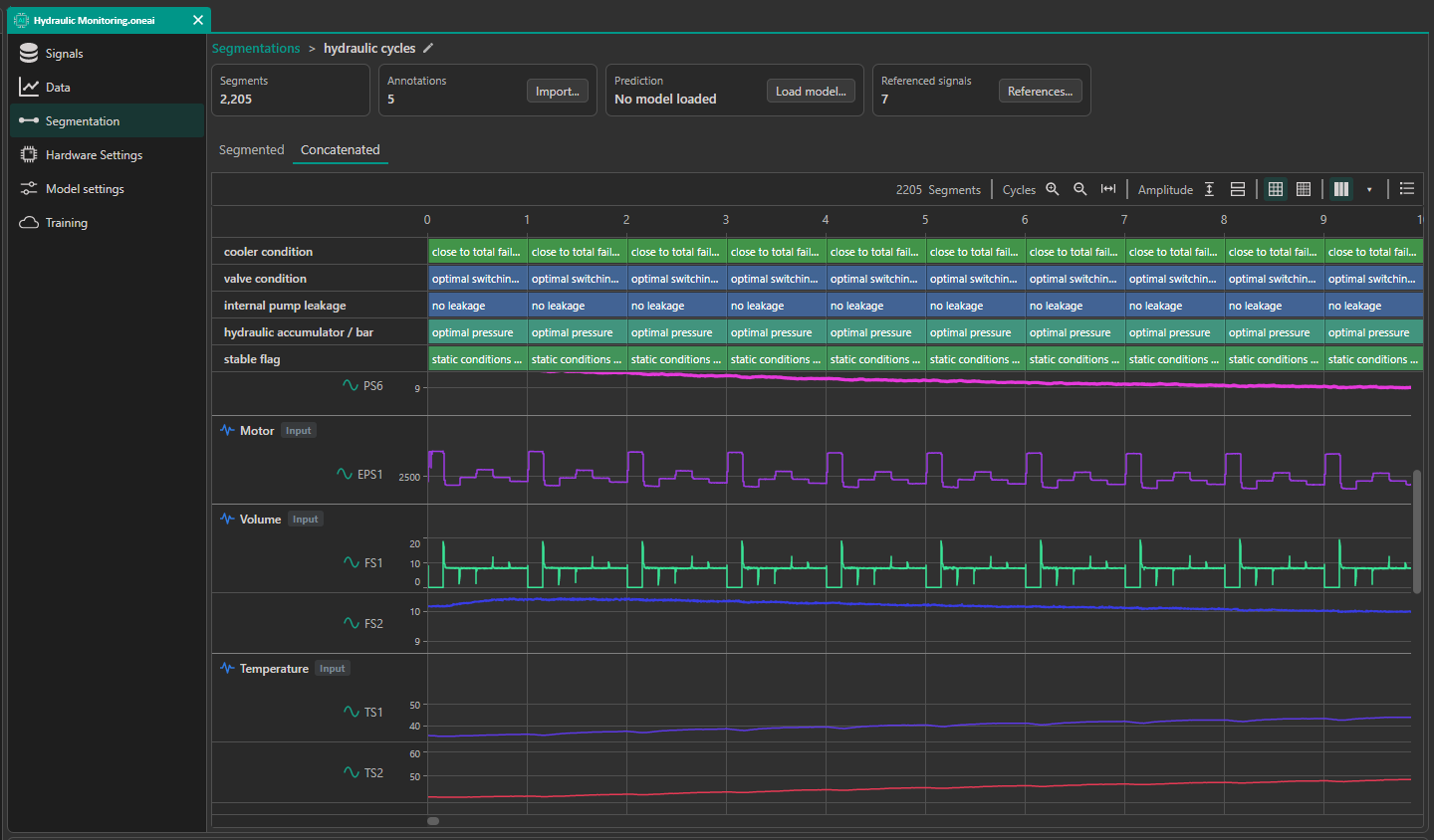
- Multiple annotations per segment: label "valve condition" and "pump leakage" on the same cycle, with descriptions and colors for each value.
- Open storage: projects are based on HDF5, an open standard for large datasets.
Importing is straightforward: bring in TXT or CSV files or whole folders, including pre-segmented data. Annotation files are checked against your segmentation automatically.
See Every Cycle
Each segment opens in fast, interactive charts with one value axis per channel and a shared time axis. Pan, zoom and auto-scale with mouse and keyboard, resize charts as needed, and see your annotations as colored lanes aligned directly above the signal. Every annotation can get its own color palette and can be toggled on or off.
What Comes Next
The goal is clear: train a model from your annotated segments in exactly the same way you already do with images in ONE AI, and deploy it to your hardware. Training is still in development, and we will share more as it takes shape.
Help Us Shape Sensor Analysis
Do you monitor machines, presses, pumps or other equipment with sensors? We would love to hear about your use case. Real-world data and requirements help us shape Sensor Analysis before release, from the sensor types and sample rates you work with to the conditions you want to detect.
Tell us about your application through our contact form and we will get back to you.